Your Cart is Empty



Hyperforin is a natural compound extracted from the St. John's wort (Hypericum perforatum) plant. Only in the past few years have researchers discovered that hyperforin is the primary compound responsible for the mood-enhancing effect of St. John's Wort.5 Many St. John's Wort products contain little or no hyperforin, but the premium extract in AMORYN contains at least 3% hyperforin, the proven potency.
Hyperforin exhibits significant activity to promote mood and support emotional wellbeing.1 Biochemical research suggests that hyperforin inhibits the reuptake of the neurotransmitters norepinephrine, serotonin, and dopamine.2 All three of these compounds are naturally found in the brain and regulate mood and emotion. They are called "neurotransmitters" because they are chemical messengers that transmit information between nerve cells. An imbalance of serotonin, norepinephrine, and/or dopamine can cause poor mood and negative emotions like sadness. By acting as a "reuptake inhibitor", hyperforin may increase the levels of these neurotransmitters in the brain, which can improve mood and restore emotional balance.3,4Hyperforin may also inhibit the reuptake of GABA, a neurotransmitter that increases relaxation and reduces anxiety.
The ability of any St. John's Wort extract to support a healthy outlook depends mainly on its hyperforin content. In other words, only St. John's Wort extracts with significant amounts of hyperforin are likely to be effective. This fact was confirmed by a clinical trial, involving 147 people, which compared a placebo (i.e. sugar pill) to two different St. John's Wort extracts with varying amounts of hyperforin. One extract contained only 0.5% hyperforin, a concentration similar to many brands sold in the United States. The other extract was standardized to provide 3% hyperforin, a high concentration similar to that found in AMORYN's European extract. (Aside from hyperforin content, the two extracts were identical. Both extracts were standardized to contain 0.3% hypericin, the compound previously thought to be the active constituent in SJW.) The 5% extract was found to effectively improve mood and reduce feelings like sadness and anxiety, but the 0.5% was ineffective and performed no better than placebo.6 This study demonstrates the importance of choosing a St. John's Wort extract that, like AMORYN's, is standardized to contain a high concentration of hyperforin.  An extensive body of research, consisting of over a dozen controlled clinical trials, demonstrates the effectiveness of hyperforin-rich St. John's Wort extract for improving mood.2,7,8,9,10 Because most studies used extracts containing at least 3% hyperforin, this research does not necessarily apply to SJW extracts without a standardized quantity of hyperforin (such as those commonly available in the United States).
Furthermore, clinical research suggests hyperforin is safe and unlikely to cause side effects.7,9 Few natural remedies are backed by as much scientific evidence as hyperforin-rich St. John's Wort extract, so please feel free to review the clinical research for yourself.
Unfortunately, few St. John's Wort products contain a standardized amount of hyperforin. You never know what you're getting when you buy a SJW product off the shelf. While some brands contain enough hyperforin to improve mood, many contain little or none. In fact, a recent study tested eight brands sold in the United States and found that only two contained more than 1% hyperforin. In short, high-quality SJW extracts are proven to be an effective mood remedy, but most SJW products on the market may be ineffective because they contain very little hyperforin. This fact motivated us to develop AMORYN.
AMORYN contains hyperforin-rich St. John's Wort extract, standardized to 3% hyperforin. AMORYN's SJW extract is the same one used throughout Europe for mood issues and used by researchers in many clinical trials. Each dose (two capsules) of "potency assured" AMORYN contains 36mg of hyperforin (from 1200mg of St. John's wort extract with at least 3% hyperforin), so you can be sure that you're receiving the optimal amount.
The graph below shows the results of AMORYN's high hyperforin content and industry-leading quality-control standards: More than three out of four AMORYN users say that AMORYN is superior to other products containing St. John's Wort (in informal online surveys of AMORYN users). Order AMORYN now to harness the healing potential of hyperforin.

Return to AMORYN ingredients.
(1) Muruganandam AV, Bhattacharya SK, Ghosal S. (2001 Dec). Indian Journal of Experimental Biology.
(2) Laakmann G, Jahn G, Schule C. (2002). Nervenarzt.
(3) Teufel-Mayer R, Gleitz J. (1997 Sep). Pharmacopsychiatry.
(4) Calapai G, Crupi A, Firenzuoli F, et al. (1999 Jun). Journal of Pharmacy and Pharmacology.
(5) Di Carlo G, Borrelli F, Izzo AA, Ernst E. (2001 Nov). Trends in Pharmacological Sciences.
(6) Laakmann G, Schule C, Baghai T, Kieser M. (1998 Jun). Pharmacopsychiatry.
(7) Gaster B, Holroyd J. (2000 Jan). Archives of Internal Medicine.
(8) Schulz V. (2002 Jul). Phytomedicine.
(9) Whiskey E, Werneke U, Taylor D. (2001 Sep). International Clinical Psychopharmacology.
(10) Kasper S, Dienel A. (2002 Nov). Psychopharmacology (Berl).
(11) Szegedi A, Kohnen R, Dienel A, Kieser M. (2005 Feb). British Medical Journal.
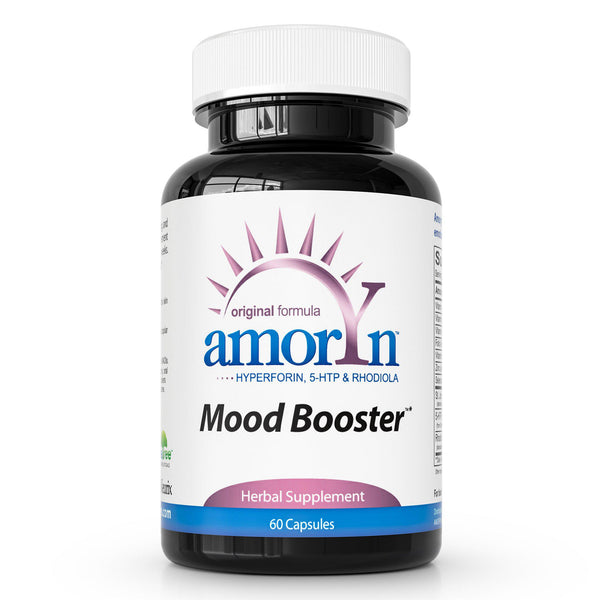
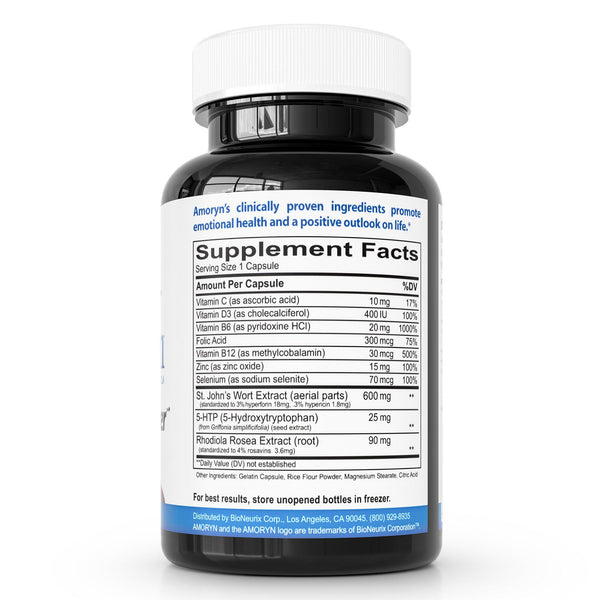
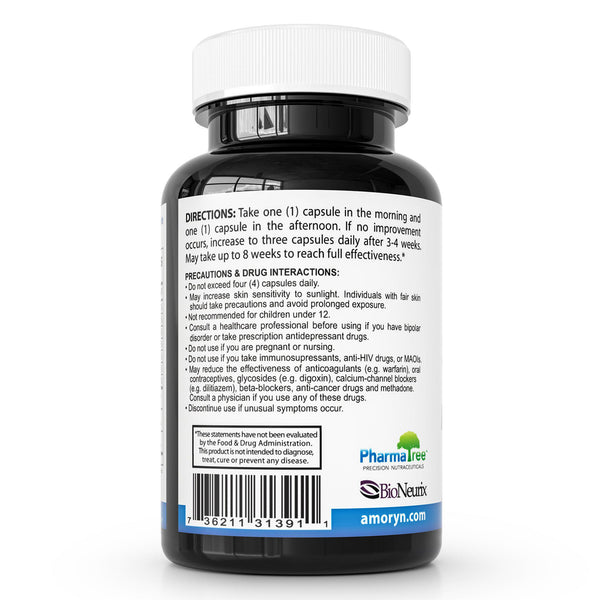

Amoryn Mood Booster helps support all three of the brain's "feel good" neurotransmitters. By providing an all-natural boost to serotonin, dopamine, and norepinephrine, the ingredients in Amoryn can help you feel happy, calm, confident, and promote a positive outlook.
$39.95 30 days supply (60 caps)